
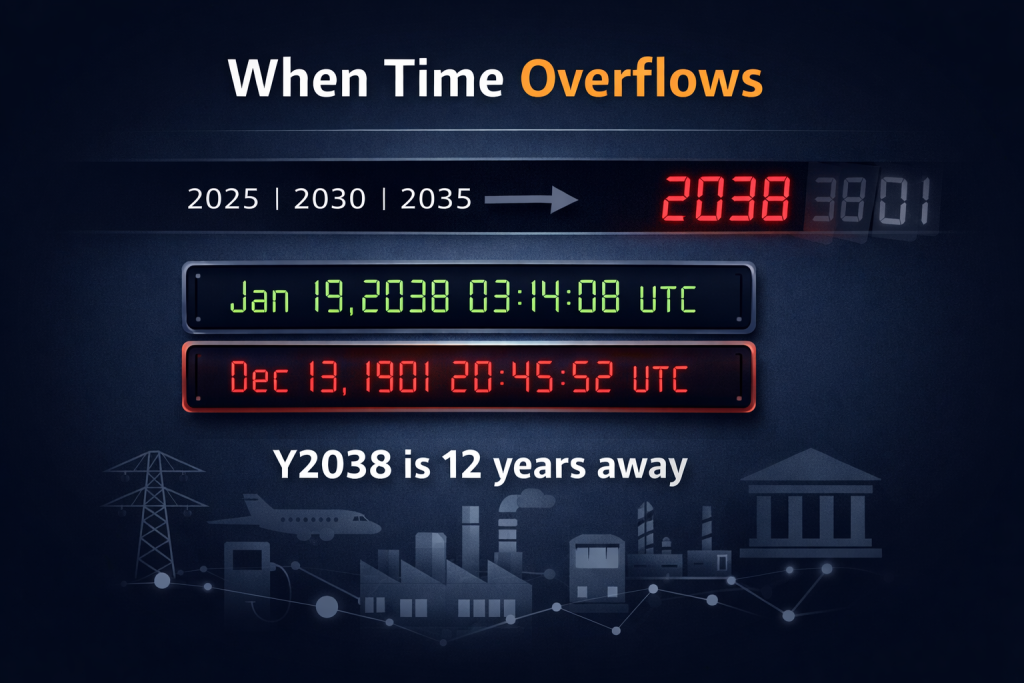
Y2038 Is 12 Years Away. Here Is Why It Matters.
The classic moment is January 19, 2038 at 03:14:07 UTC, when a signed 32-bit Unix-style timestamp reaches its maximum value and overflows. (In some systems, the first “bad” timestamp is one second later.)
Twelve years sounds like a long time. In hardware and software development, it is not.
A quick reminder: what is Y2038?
Many systems represent time as “seconds since January 1, 1970.” If that counter is stored in a signed 32-bit integer, it eventually overflows. That can cause time to jump backward, dates to become invalid, or time-based logic to behave unpredictably.
The important point is this: Time is a hidden dependency everywhere.
Why “12 years away” is a real planning horizon
If you work in tech, you have seen this movie before. The deadline feels far away, until it suddenly is not.
Many of the systems most likely to be affected are not laptops and phones. They are the hidden systems that tend to remain in service for a long time:
· long-lived embedded devices
· operational technology (OT) and industrial controls
· certified and regulated systems
· equipment that is costly or difficult to take offline
· products with supply chains and third-party components you do not fully control
Those systems commonly have life cycles measured in decades, not years. If a device is being designed today, deployed next year, and expected to run 10 to 20 years, it is absolutely within the Y2038 window.
“We are 64-bit now, so we are safe,” right?
Sometimes. Many mainstream 64-bit operating systems handle time in a way that pushes the problem far into the future.
But organizations can still be exposed because Y2038 risk can hide across layers:
· firmware and device drivers
· RTOS and embedded Linux builds
· C libraries and middleware
· protocols and data formats that embed 32-bit timestamps
· applications that cast or store time in 32-bit fields
· logs, audit trails, billing intervals, certificates, and safety interlocks
Even if your servers are 64-bit, a small subsystem, device, or router can still be the weak link.
Where industrial impact is likely to show up
People often ask, “What may actually break?” Here are a few easy-to-understand examples across infrastructure sectors:
· Banking and finance: ATMs, point-of-sale terminals, payment gateways, settlement and fraud systems
· Communications and internet: routers and firewalls, cellular network elements, authentication and accounting, PKI and certificate handling
· Energy: substation protection devices, SCADA monitoring, smart meters, pipeline SCADA, refinery control systems
· Healthcare: patient monitors, infusion pumps, imaging systems, lab analyzers, pharmacy dispensing and audit systems
· Transportation: air traffic support systems, aircraft avionics, rail signaling and onboard systems, automotive telematics and EV charging, traffic management controllers
· Water and dams: telemetry and gate controls, pump station controllers, leak detection, metering and billing
Y2038 may or may not cause the systems above (and many others) to fail dramatically. More often, failures may be subtle. A timestamp bug can lead to failed authentication, incorrect billing, broken scheduling, corrupted logs, or safety logic that refuses to operate.
Why is Y2038 still not solved everywhere?
This will feel familiar to anyone who has worked on legacy systems:
· limited awareness outside specialist circles
· incomplete inventories of what is deployed and where
· no universal fix that automatically covers every layer
· compatibility issues when changing time representations
· downtime and certification constraints
· testing, verification, and controlled rollout are expensive and time-consuming
· a “not urgent yet” mindset and economics
What to do now: a practical checklist
No need to panic, but it does deserve planning.
If you operate or build systems that may live into the 2030s, these steps pay off:
1. Inventory where digital time exists: hardware, applications, firmware, OS, libraries, protocols, data formats.
2. Identify 32-bit time assumptions, especially in embedded systems, logs, and data interchange formats.
3. Engage vendors early and ask direct questions about Y2038 readiness and upgrade paths.
4. Add Y2038 tests now: time-travel tests in CI, simulation rigs, and staging environments.
5. Plan remediation paths: 64-bit time where possible, careful alternatives where not.
6. Treat it as resilience engineering: not just “passing 2038,” but preventing time-related failure modes that can happen earlier (or later).
Final thoughts
Y2K worked out as well as it did because organizations took it seriously and invested in assessment, remediation, and testing.
Y2038 will not fix itself. But it is not mysterious or unfixable. We know where it lives, which systems are most exposed, and the upgrade paths that work.
Twelve years is enough time to do this the right way. It is not enough time to ignore it for another decade.
If you would like a deeper technical update, I have additional information at Y2038.com. I am always interested in helping organizations assess and mitigate exposure, or share lessons learned.

4 Responses